Personal security
Self-defense vs. personal security training: what is the difference?
Self-defense classes focus on what to do once a confrontation is physical. Personal security training covers the decisions that come long before.
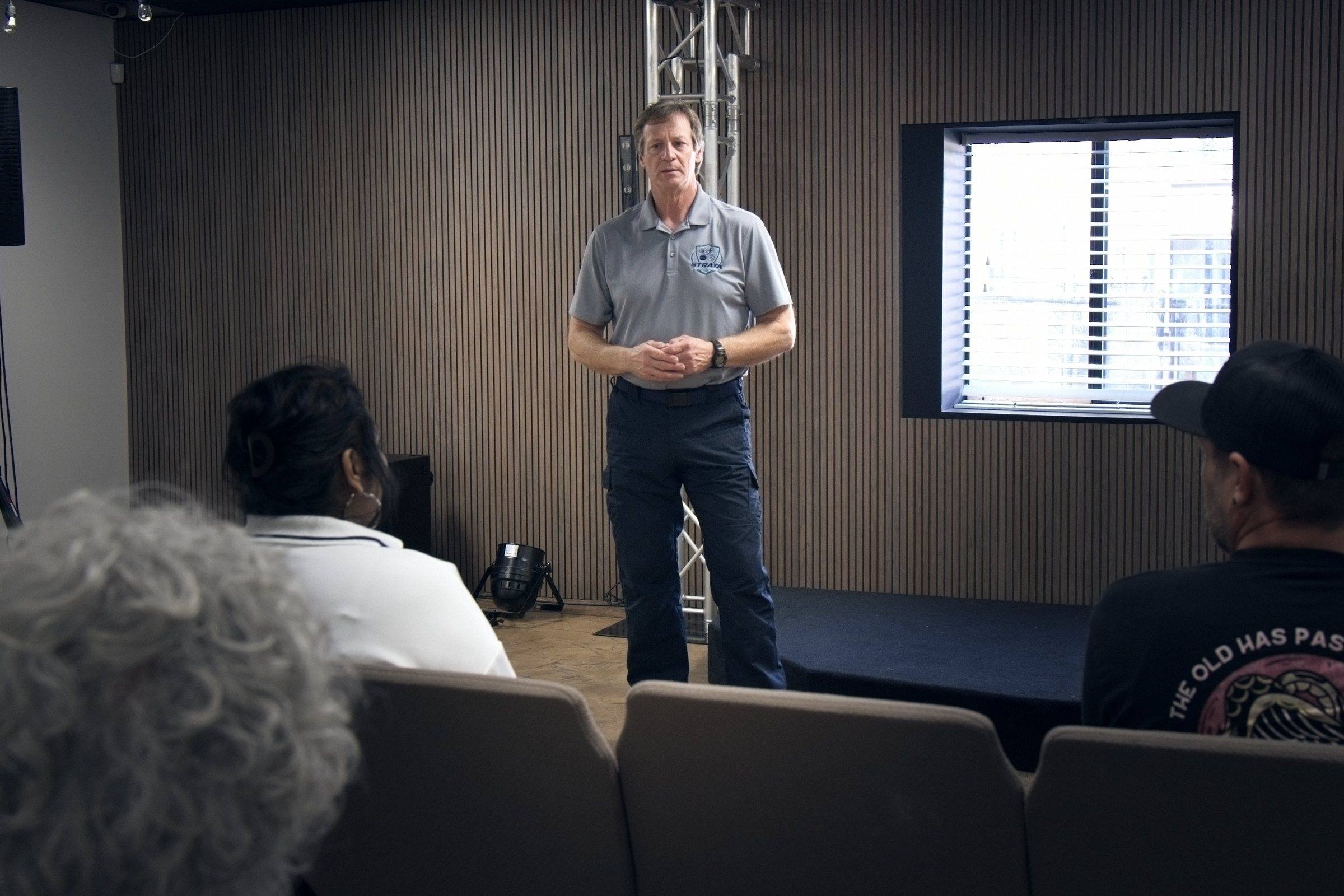
If you search for a class to help you feel safer, most of what you will find is listed as self-defense. Many of those classes are good. But the label points to a narrow slice of what keeps people safe. Strata uses a different term, personal security training, because the physical part is only one piece of a larger system.
What a typical self-defense class focuses on
A self-defense class usually starts at the moment of contact: someone grabs you, swings at you or pushes you, and you learn how to respond. Strikes, releases and escapes are valuable skills, and Strata teaches them. The limitation is the starting point. By the time someone has a hand on you, many of the options you once had are gone.
What personal security training adds
Personal security training starts earlier, at the moment you could first have noticed that something was off. Strata organizes it into four layers, taught in the order they occur in real life:
- Awareness: recognizing what is happening around you before it becomes a problem.
- Avoidance: identifying options, creating distance and making choices that reduce unnecessary risk.
- Communication: setting boundaries, maintaining control and helping de-escalate a difficult situation.
- Physical response: walking or running away, moving to a better position, using body language to control the situation, and practical techniques for when that is not enough.
The first three layers do most of the work. They are also the layers people use most often in ordinary life: choosing not to walk through a dark shortcut, crossing the street, speaking firmly to someone who is crowding them, leaving a gathering that is starting to turn.
Why the order matters
Each layer gives you more options than the one after it. When you notice early, you can avoid. When you cannot avoid, you can often talk. Hands-on physical techniques are the narrowest set of options, and they carry the most risk for everyone involved. Training that only covers the last layer leaves people with one tool for every problem.
There is also a mental side. People who have thought through the earlier layers tend to stay calmer when something does happen, because they are not encountering every piece of it for the first time. Strata's Level 1 includes mental and physical preparation for this reason.
The physical layer still matters
None of this means physical skills are unimportant. Physical response is also broader than most people assume: it includes walking or running away, moving to a more strategic location and using body language to control a situation. Sometimes that is not enough, and a person needs to protect themselves. Strata's Level 1 introduces practical techniques. Level 2, for Level 1 graduates, builds them into movement, blocking, striking, counters, escapes, grabs and ground encounters. The difference is that students arrive at the physical work already understanding where it fits.
Which one is right for you
If you want a fitness-oriented class or a long-term martial art, a traditional school may be a good fit. If you want practical preparation for the situations ordinary adults actually face, with physical skills taught in context, personal security training is the more complete starting point.